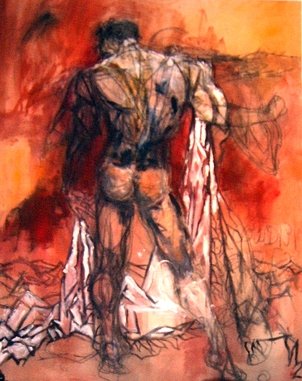
 Man with drapes is called man with drapes because there is not another good name for it. A man stands, picking up some drapes. This was one of the first of my “progressive painting” experiments, in which I worked primarily in charcoal, then liberally applied paint, then alternated back to charcoal, and so forth in a pattern cycle that eventually became “constant revision” and changing of position, color, etc. I searched for a surface full of movement, uncertainty, but also shape and form. Making art this way, it is impossible to know when to stop revising or beginning a new cycle for the piece. At a point, I believe the art tells you when to stop. If the artist feels it is unfinished, then it is up to the viewer to finish it.
Unfortunately for man with drapes, there were very few viewers. This painting featured in a solo show at the now defunct Pi Bar (a MPLS GLBT night club), then hung on my studio’s wall for awhile. When I went to France, the boyfriend of a friend threw it in a dumpster after they had a fight. A loyal girlfriend of mine drove to the suburbs to rescue the piece, which was returned to me upon my return from France, months later. Man with drapes hung happily on my studio apartment wall for a time, and it was the favorite painting of my then long-distance boyfriend. When we broke up, I was maudlin. I piled all things that reminded me of him into a box, including a tiny plastic christmas tree, and this painting. I had ripped it from its stretcher and rolled up the canvas, shoving all into a box. I was going to send everything to him, but instead the box sat in my closet for over a year. Much later, in a purging mood, I decided to throw out the box. I had forgotten man with drapes was there entombed, and didn’t bother to remove the layers of packing tape securing the carton’s edges. Ultimately, man with drapes met his end in a crappy neighborhood dumpster, and is now lying buried under a trash heap, I presume.
Reckless abandonment of art is a shame, I have learned, because instead of anybody finishing it at all, it winds up finished by a dump truck! This is the only surviving image of that painting left. Le sigh… Original size was 4 ft x 5ft, acrylic on hand-built and -stretched canvas.







 Dad is the hunter. Mom is his cheerful accomplice. Before the Cities, I accompanied Dad, chasing pheasants I could rarely mark, using Mom’s multicolored shotgun. Once, I tracked a whitetail with Dad. We crawled yards that November day, dragging our bodies along scrub. Dad cut a crablike path leading to a perfectly triangulated shot at our resting game. Long after, I felt like a weakling for popping the rifle trigger and aiming way low, blasting the South Dakota prairie in the face to spare the doe her life. Her coal eyes had fanned pity in me; I couldn’t take her, snuff her out. I don’t know if he was aware I pardoned the whitetail, spoiled the kill. Now, we were driving west to track larger game. The Sioux call them “wapiti,” Dad told me. Mom called our truck “White Magic Bus,” with I-90 west miles tumbling behind us.
  Enjoying a glass of 4 PM champagne after landing at a wind-beaten beach bum bar full of sandy cracks, all-state auto plates, and live, maybe authentic Cuban guitar. Of course the first thing we do after landing is head straight for the shack-studded cocktail beaches – in this case, Siesta Key.