Winter’s Mirror – Selfie Portrait

Selfie portrait
Selfie taken with phone, sketched on newsprint

It has been awhile since I posted anything, but that’s not to say I haven’t been busy. This time of year in Minnesota, the dark winter days are dragging on and each week brings a fresh few inches of snow, which now is melting into deep black pools of chilled, creeping mud. The last several weeks have been cold enough that it’s not worth leaving one’s apartment save for the most obligatory of activities. The Midwestern cabin fever has certainly set in.
Continue reading

Des couleurs, des corbeaux

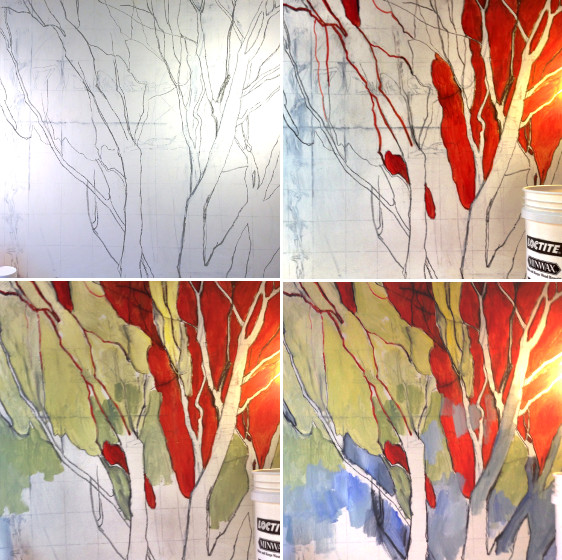
Color and form progression

In my relationship to color, I have never been careful.

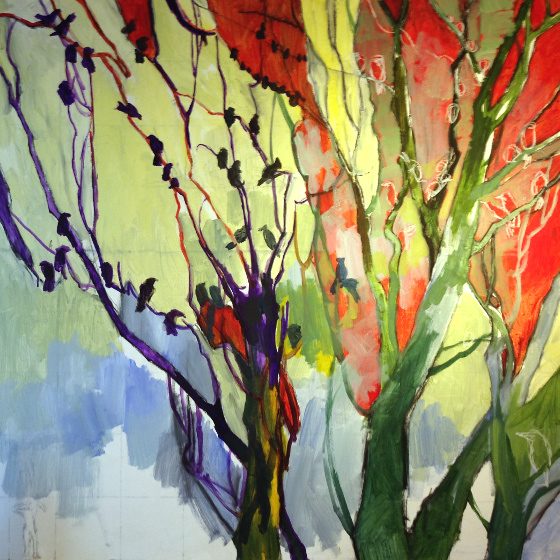
I’ve just arrived at the end of my next session on this painting, and I can see some rudimentary color “themes” coming forward and some birdlike things happening with form. I began developing the color fields and establishing the noisy, frenetic lines of the tree branches – the painting has begun to take on a more significant weight. The experimentation with hue usually takes place right on the surface of the canvas, and if I don’t like what is happening, I treat it as a challenge that must somehow be incorporated or subordinated.
Continue reading

About: Color

Initial color progressions

Starting a new painting is exciting. There are so many possibilities to consider, and watching where the piece begins to move, stepping back every twenty or so minutes, helps decide whether the formal decisions are beneficial or useless. The composition of this piece comes from a photograph I took in a friend’s backyard after I helped him dig a ditch for a French drain at his new house. I was exhausted and sweating, and looked up to see sun filtering through the changing leaves of Minnesota’s autumn. I snapped a quick picture and translated the tree forms onto this square canvas.

My formal goal with this piece is only to explore the possibilities of color, starting with stark fields in a slightly geometric formation, and build them slowly to maximize subtleties. I have a lot of ideas for how to proceed as the colors develop, but for now I’m enjoying the simple rapports between the hues and tones cutting up the white space.

White space can be intriguing in its absence (as I wrote in my last post) however when I start again with a solid idea, it’s a race to get rid of it, to fill up that void with something physical, workable, without destroying the potential of the surface. The image is taking form and life and breathing all that open, white air to begin its own progress towards something unique in its own. The artist is the image’s careful guide, in this case.

ABOUT:BLANK

About:Blank
About: Blank

One of the greatest and most valuable gifts of painting is the relative ease with which one can simply wipe the slate clean and start anew. Palette knife is the tool – I chop into the surface with rays of pure white gesso and efface all that was there before, smothering the old composition, which fades into a place of secondary importance, an array of thoughts now removed. With each bolt of new paint, the material matrix breathes again, and the islands of old charcoal and color shrink down until they are obscured by broad blinds of new paint.

The newly blank field is at once a chance to forget the old and begin with a fresh absence, a novel idea in a consciousness too often cluttered with useless nostalgia, hapless could-have-beens. When the blind patching is complete, there is a moment of satisfaction in nothingness, and an urge to stop just there, existing within the transitional space. This is the space of balance after withdrawal, and the measured breath just before the next effort. The ecstasy there is the elusive sense of endless opportunity within the walls of the canvas. It is often most difficult to begin again and fill the space with a new idea that will grow and learn and change, and perhaps become redundant.

I’m questioning every time if it is possible to prolong the sense of unknowing and suspended creative potential. Is it even plausible in panting, which produces an obligatory fixed image?

What a shock to make the first mark in that clearing and let the new imaginary shapes take life, physical form. And always, in my work, where the initial becomes an echo, the old redundancies may ascend again to inform the new.

M. lucifugus: cauchemar

myotisLucifugusDone
Myotis lucifugus, or the little brown bat, is the most common species of mouse-eared bat in North America. Several encounters with these guys have made me quite familiar with them, from having to trap them in my apartment building – scary – and let them go outside, to watching them zoom around in the evening catching mosquitoes before a movie in the neighborhood park. From the Minnesota Department of Natural Resources “Living With Wildlife”:

  • Bat Fact 1: Bats will not fly into our hair.
  • Bat Fact 2: Bats are of benefit to humans.
  • Bat Fact 3: There are ways to get rid of bats without killing them.

Continue reading

The Raucous Group

The Raucous Group
The Raucous Group. Acrylic, charcoal on canvas. 18″ x 24″

In “The Raucous Group” I’m still exploring themes of human bodies in relation to space as in “Man with Drapes” and “Tuberculosis.” The figures find themselves in a somewhat neutral zone of abstraction, however in this piece their surroundings begin to take on a little more form.

While working on this painting I was trying to move away from these sort of amorphous, indefinite environments I was placing figures in. Realizing I was getting too comfortable with overworking the figures themselves and paying little attention to their physical “place in space,” I attempted to build the environment with as much intent and care as I constructed the figures. For me this was challenging – most of our structured human environments are rigid, geometrical, which doesn’t lend itself to the fluid energy-based stroke I was used to. I layered the interest in the background and foreground using a combination of color washes, “dredging” with charcoal and paint, and copious applications of medium with a palette knife.

Continue reading

We Were Warned About Time (Excerpt)

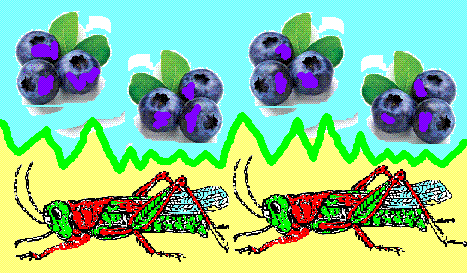
Blueberry and Grasshoppers

“Ook-see-kook-see-koo-la-ma-vee!” Dad is yelling at our irreverent laughter, as we bounce along in his old truck, heading north into the pine lands above the prairie of my childhood. On our way to the Hiawatha Festival, the long, even Minnesota plains highway has buckled into sudden hills, the truck jaunting up and down, and my sister and I are throwing our tiny hands up – the family truck has become a roller coaster.

“Ook-see-kook-see-koo-la-ma-vee! The grasshoppers are gone, it’s Saint Urho’s day!” The legend of Saint Urho, as bellowed happily by Dad, involved an embattled plague of locusts pursued by a giant exemplar, armed with a pitchfork and some irresistibly humorous gibberish. Long ago, Urho drove the insect horde out of Finland because they threatened the grape harvest, and the Finns were so rapturously thankful for the salvation of their wine-making crops, they beatified the brute…or so the story is told by Dad. In other, more esoteric versions, Saint Urho was known to drink large quantities of pungent fish stew, which in turn gave him a supernatural vocal quality. Full of piscine broth and thunderous of voice , the great Saint yelled nonsense and rhymes, shattering the ears of the grasshoppers. They were sent swarming away, holding their heads, toward more quiet and hospitable crops. Still, other versions indicate Saint Urho was simply someone’s joke, a figment conjured from imaginations of some area drinking buddies, more out of jealousy for the Irish Saint Patrick than out of pious observance.

Quixotic, retired exterminator Saint Urho stands at the Gateway to the Pines in caryatid relief, gazing down the quiet highway towards those who approach Menahga. The blueberry town at some point adopted Urho as its patron and protector, and the story was passed down by the jealous Finns who may have dreamed him up. I think of him as a benevolent presence between the birch and pine woods surrounding these fading central Minnesota towns. In Menahga the veracity of the Saint’s tale doesn’t matter, only that his legendary protection is important, even though most everybody there is Lutheran.

Tuberculosis

Tuberculosis. Acrylic & charcoal on canvas. 36" x 48"

Tuberculosis: an infectious disease that may affect almost any tissue of the body, especially the lungs, caused by the organism Mycobacterium tuberculosis, and characterized by tubercles. Random House Dictionary, © Random House, Inc. 2013

Where does the soul meet the body, and how does the body approach the soul? Does a human being have an internal flame? How is it affected by entropy? Where is it located in anatomy, in physiology, in pathology? Thoughts on: Kuriyama, Shigehisa. (1999). The Expressiveness of the Body and the Divergence of Greek and Chinese Medicine

Rebirth of Venus

Rebirth of Venus
“Rebirth of Venus” (a working title) is an in-progress piece that is a rebuild of Sandro Boticelli’s famous 1486 “Birth of Venus,” a commissioned painting for the Medicis of Florence. This piece is more or less an exercise in compositional elements and an attempt to explore a painting style that is both very beautiful and very different from my own. The piece is being built in several layers, having started with a flat plane of gesso divided by a grid which I used to carefully enlarge each element of Boticelli’s composition. The “canvas” is a large piece of cardboard divided into a 1×1 inch square grid…I think people use these for patterning/sewing textiles. The painting can be folded up. Challenges are tending to be uniform color balance and overall conformity of brush stroke quality, mostly due to several short periods of work on different sections rather than long sessions working the whole surface. Continue reading

Man With Drapes, Misadventures

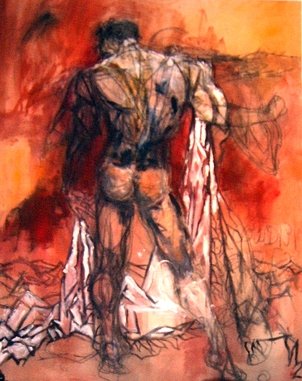
Man with drapes is called man with drapes because there is not another good name for it. A man stands, picking up some drapes. This was one of the first of my “progressive painting” experiments, in which I worked primarily in charcoal, then liberally applied paint, then alternated back to charcoal, and so forth in a pattern cycle that eventually became “constant revision” and changing of position, color, etc. I searched for a surface full of movement, uncertainty, but also shape and form. Making art this way, it is impossible to know when to stop revising or beginning a new cycle for the piece. At a point, I believe the art tells you when to stop. If the artist feels it is unfinished, then it is up to the viewer to finish it.

Unfortunately for man with drapes, there were very few viewers. This painting featured in a solo show at the now defunct Pi Bar (a MPLS GLBT night club), then hung on my studio’s wall for awhile. When I went to France, the boyfriend of a friend threw it in a dumpster after they had a fight. A loyal girlfriend of mine drove to the suburbs to rescue the piece, which was returned to me upon my return from France, months later. Man with drapes hung happily on my studio apartment wall for a time, and it was the favorite painting of my then long-distance boyfriend. When we broke up, I was maudlin. I piled all things that reminded me of him into a box, including a tiny plastic christmas tree, and this painting. I had ripped it from its stretcher and rolled up the canvas, shoving all into a box. I was going to send everything to him, but instead the box sat in my closet for over a year. Much later, in a purging mood, I decided to throw out the box. I had forgotten man with drapes was there entombed, and didn’t bother to remove the layers of packing tape securing the carton’s edges. Ultimately, man with drapes met his end in a crappy neighborhood dumpster, and is now lying buried under a trash heap, I presume.

Reckless abandonment of art is a shame, I have learned, because instead of anybody finishing it at all, it winds up finished by a dump truck! This is the only surviving image of that painting left. Le sigh… Original size was 4 ft x 5ft, acrylic on hand-built and -stretched canvas.

Getting Wild

Wapiti Wild Dad is the hunter. Mom is his cheerful accomplice. Before the Cities, I accompanied Dad, chasing pheasants I could rarely mark, using Mom’s multicolored shotgun. Once, I tracked a whitetail with Dad. We crawled yards that November day, dragging our bodies along scrub. Dad cut a crablike path leading to a perfectly triangulated shot at our resting game. Long after, I felt like a weakling for popping the rifle trigger and aiming way low, blasting the South Dakota prairie in the face to spare the doe her life. Her coal eyes had fanned pity in me; I couldn’t take her, snuff her out. I don’t know if he was aware I pardoned the whitetail, spoiled the kill. Now, we were driving west to track larger game. The Sioux call them “wapiti,” Dad told me. Mom called our truck “White Magic Bus,” with I-90 west miles tumbling behind us. Continue reading

Shadow Palm


Shadow Palm (working title)
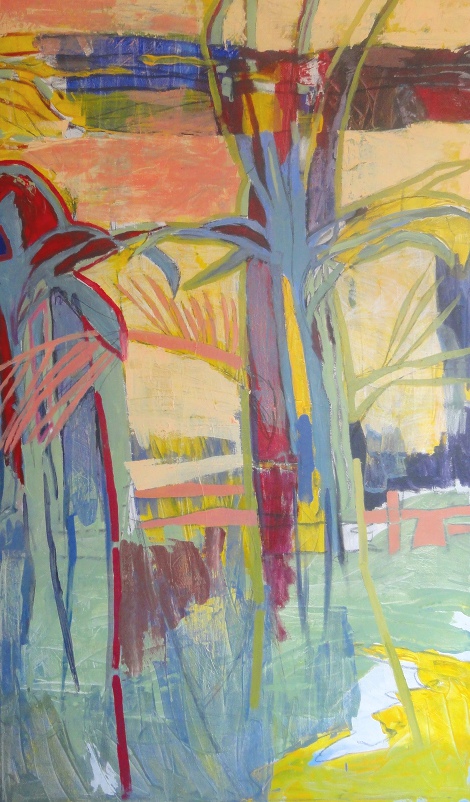
This is a large painting started in my bedroom. I had this big canvas leaning against my wall and woke up one night to see shadows playing on the surface. I decided to trace the shadows in the middle of the night, which were coming from light outside interacting with my palm tree (now dead!), and begin a “progressive” painting with multiple sessions of tracing and then painting. It’s still not finished, but it makes a nice decoration for now. Hoping to “finish” it this summer.