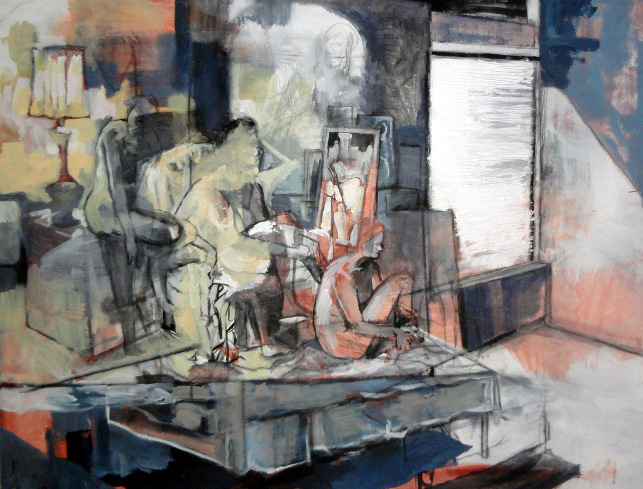
And now for a post about art from the (not so) distant past … Six years ago, I was in art school stretching my own humongous canvases, spending hours and hours pondering and journaling on the perilous possibilities of form, content, and the place of painting. This is a piece I’ve been living with ever since. I think I’ve shown it maybe three times, but for the last several years it has occupied a lonely place in my bedroom. I recently re-hung it on a wall, where paintings belong.
Reconsidering this painting now, having lived with it for so long and having hauled it through at least four different apartments, I have a very physical connection with it. When I was making it, I was really focused on the process, and color/composition work often were placed on the back burner. I was muddling through this sort of “constant revision” approach where I would begin something but refuse to become committed, obscure it, and start again, with the result being a sort of time warp where you can see the flux of several different sketches without a necessarily recognizable “finished” product. Adding to this, I think this particular piece was based on live models, but every 120 seconds or so they would change position, adding to the time lapse effect. This way of working I think was a precursor to my concept of “progression” or “progressive” painting, wherein the process is paramount and the “end” of the work is slippery.
However “unfinished” it was at the time, I haven’t touched it in several years and I think I can say that I probably will not return to anything on this particular canvas … So be it … Let’s call it done!

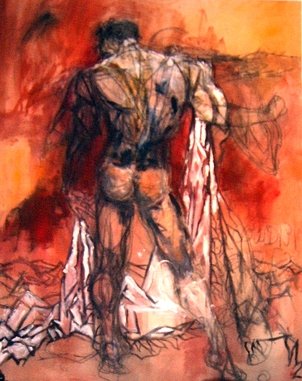 Man with drapes is called man with drapes because there is not another good name for it. A man stands, picking up some drapes. This was one of the first of my “progressive painting” experiments, in which I worked primarily in charcoal, then liberally applied paint, then alternated back to charcoal, and so forth in a pattern cycle that eventually became “constant revision” and changing of position, color, etc. I searched for a surface full of movement, uncertainty, but also shape and form. Making art this way, it is impossible to know when to stop revising or beginning a new cycle for the piece. At a point, I believe the art tells you when to stop. If the artist feels it is unfinished, then it is up to the viewer to finish it.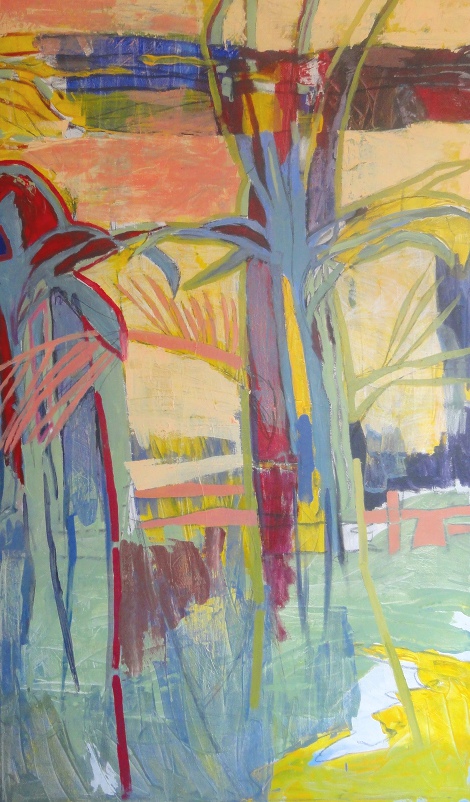
 Zach Taylor Art