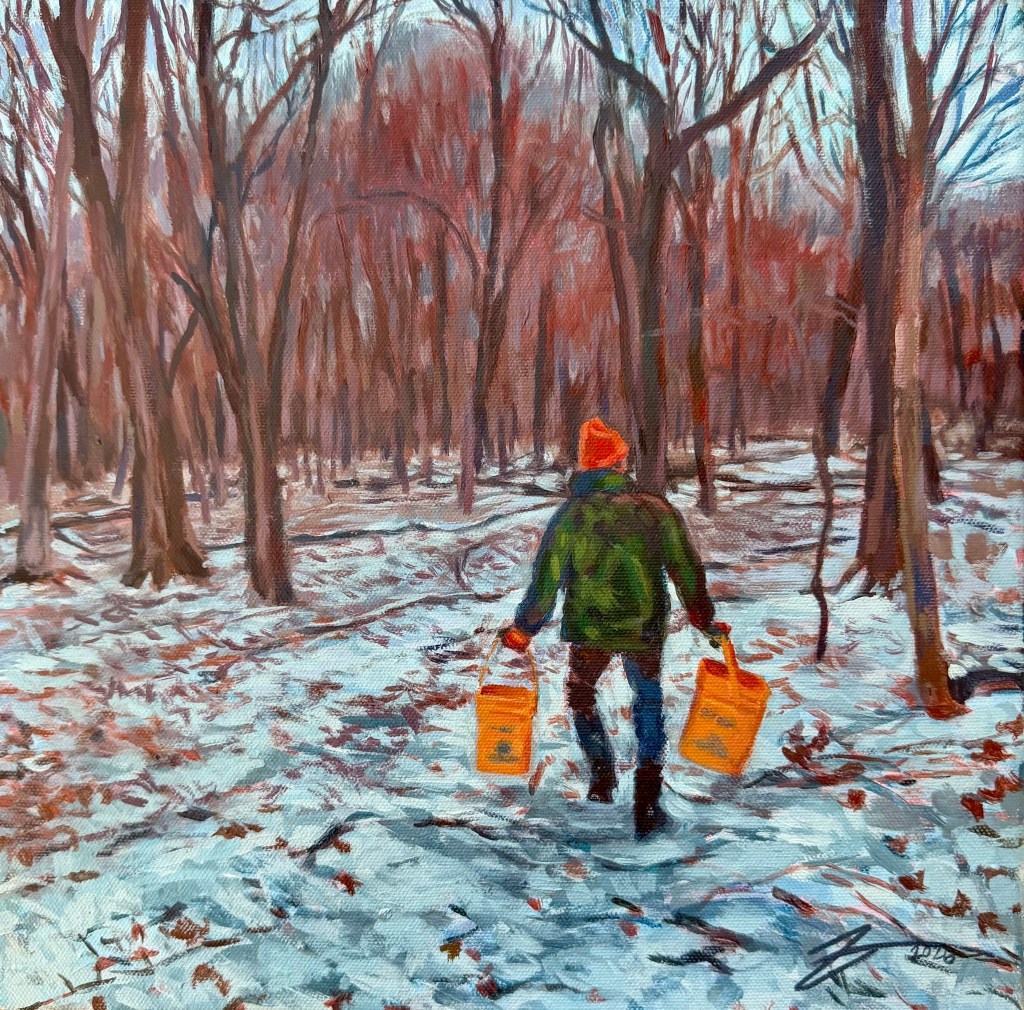
Earlier this year, a friend mentioned her father Dave taps maple trees every year for syrup. She knew how much I enjoy this kind of thing, and invited me out to come learn the process. My first morning on Dave’s land, we chatted about trees, walking through a forested area on his acreage with a stand he’s been tapping for years. The morning light was filtering gently through the bare canopy, and the freezing-thawing snow was glowing a dreamy cyan, strewn with brittle, brown-red leaves. I managed to snap a photo of this poignant scene as Dave picked his way through downed branches and into the maples. He showed me how to drill a shallow hole into the soft vascular tissue just behind the outer bark, place a little metal spigot and collection bag, and watch the sap start to run. The following week, we’d work together to boil the semi-sweet raw sap into a condensed form that could be brought inside and finished on the stove.
In this painting, I tried to capture the morning light conditions turning the early spring snowpack bright blue, and celebrate this special springtime tradition. From a technique perspective, I was most focused on developing a sense of depth in the woods, using sharper edges/shapes only where I hoped to direct the eye. The softer shapes blend into the receding atmosphere, supporting the composition and movement through the trees. This was challenging, as this woodland scene is richly textured with branches, twigs, scattered leaves and tufts of snow. The central struggle with this piece was how to avoid over-definition and “distraction by detail” when there are so many staccato elements creating noise and vibration. Deciding which elements to amplify, and which to allow to fade back, is a sure area of development for me. It’s also one of the not-so-intuitive things about working from a photograph – the eye simply doesn’t see all of the definition that is captured by a high quality photograph. A beautiful painting risks becoming “overexplained” or drowned in detail when working too closely from the photo reference.